 Documentation v0.9
What is trac
trac sits as a governed execution layer between your existing data, compute, and code infrastructure and the outputs your business depends on.
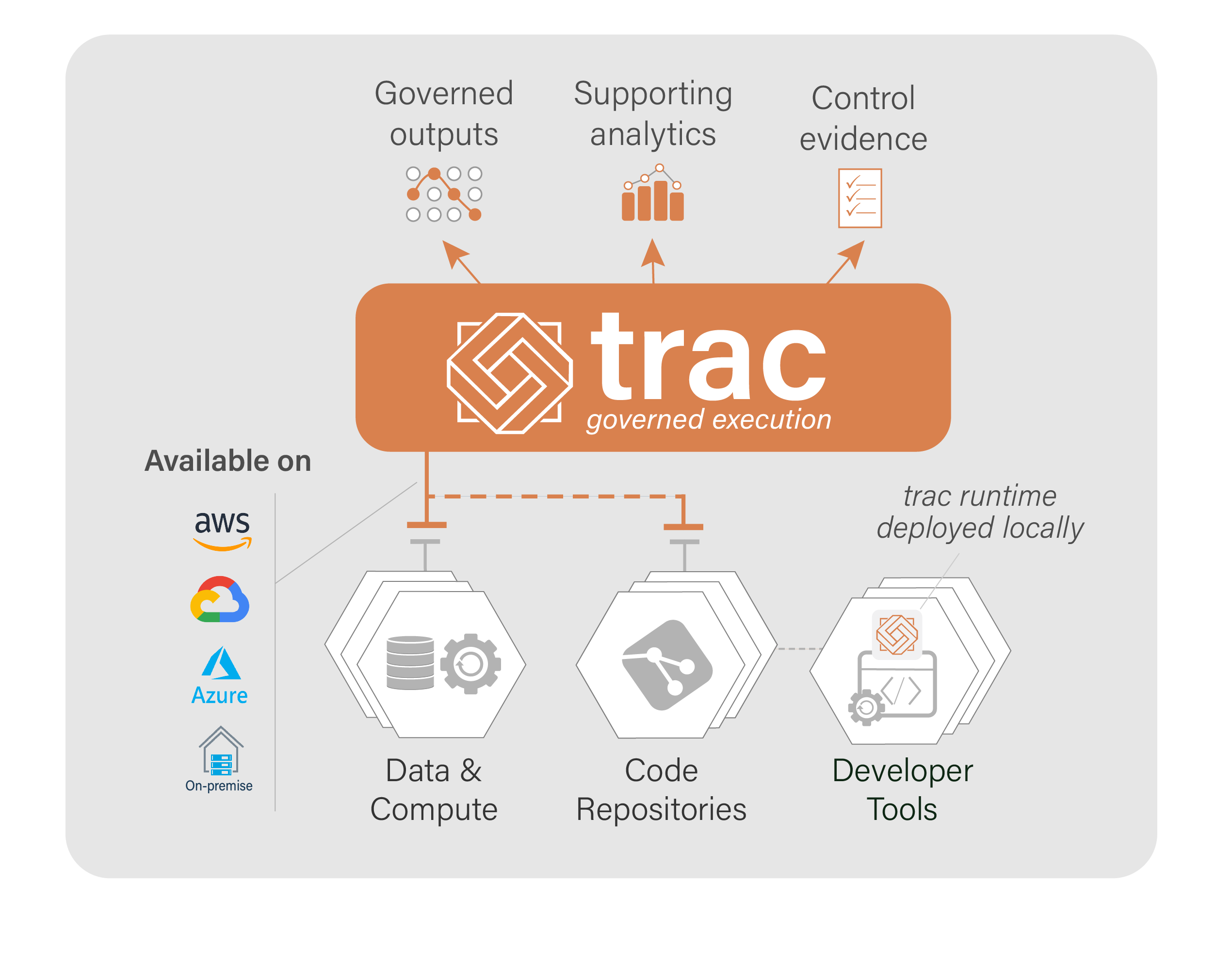
Three capabilities define what that position in the stack delivers.
Portable execution
Models are built once using the trac runtime and run consistently in any environment — local IDE, notebook, or production platform — without modification. The runtime abstracts the execution environment from the model logic, so the same model code that a developer tests on their laptop is the code that runs in production.
Intrinsic governance
Every calculation is defined by an explicit contract that drives execution and persists as the authoritative record of what was run. Lineage, auditability, and repeatability are built into execution itself — not enforced through separate documentation or manual controls. Governance is a consequence of how the platform works, not an overhead applied on top.
In-situ analytics
Every completed calculation is a preserved, reusable object. Teams can experiment directly on production models and data — varying inputs, parameters, or model versions — with full traceability and without risk to production outputs. Exploratory work and production runs share the same governed execution model.